The Formation and Conclusion of Wei–Jin Metaphysical Confucianism : Ruan Ji and Ji Kang as Its Only True Spirit
FEATUREDRUAN JI AND JI KANGWEI-JIN MEDIEVAL CHINA METAPHYSICAL CONFUCIANISMKCL
Jiahao Shen
2/26/202624 min read
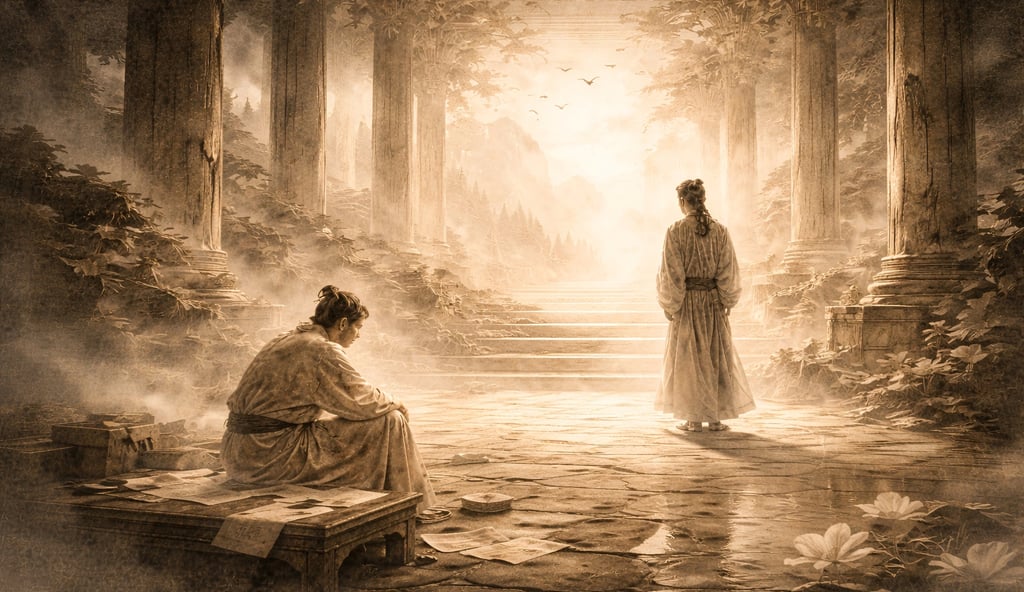
The formation of the philosophical system of the metaphysical Confucianism at the early Medieval China represented not merely the landmarked breakthrough with the established Confucian ideology and philosophy. More essentially, the Medieval metaphysical Confucianism was grounded in the conviction on the universal and ultimate metaphysical principle and order, which fundamentally reoriented the central concerns onto the sovereignty of the independent internal world with the empowerment of the freedom and idealist mind. Therefore, the Medieval metaphysical Confucianism served as the truest ideological and spiritual expression and embodiment of the aristocracy class, the class whose social structure became considerably reinforced and systematized during the Medieval period. It was particularly meaningful and relevant for the group of aristocracy intellectuals that primarily driven by the mind of idealism and freedom, which through the Medieval metaphysical Confucianism the fundamental framework and path to the completion of self-recognition and inner self could be fully articulated.
It became prominent under the period of maturity in the Wei-Jin period that the dominant philosophical influence and immersion of the metaphysical Confucianism had been deeply embedded into the cultural and intellectual realm of aristocracy class. The catastrophic collapse of the unified Jin dynasty, though in many aspects contingent and unintended, profoundly altered the cultural and ideological trajectory of the aristocracy group at the Northern China, as they were compelled to navigate the audacious and intensive struggles for the prolonged political reintegration under the formidable rule of conquering nomadic powers. But coupled with the political survival and continuity of the Southern China, the great preservation of the cultural and philosophical traditions created the conditions under which metaphysical Confucianism could continue to flourish and cultivate, thereby intensifying its cultural influence and authority among the progressively consolidated and exclusively constructed aristocracy group.
However, in term of the systematic formation and development of the philosophical system of the metaphysical Confucianism, which particularly for its philosophical visions from the grounding in the metaphysical ultimate natural order to the affirmation of the independent ontological self-creation world, had been achieved and completed during the stabilized Wei-Jin era, mirroring the initial stage of the systematic establishment of the highly independent and exclusively recognized aristocracy class.
The following Eastern Jin dynasty that preserved the Southern China and the successive Southern dynasties clearly lacked the capability for further meaningfully advancing the metaphysical Confucianism as the philosophical system, despite the significantly more organized and entrenched aristocracy structure. The aristocracy groups exhibited the pronounced tendency to be morally decayed and self-corrupted that remarkably begun under the unified Jin dynasty and further deepened during the prolonged period of Southern dynasties, which the trajectory corresponded coherently with the increasing ascendancy and dominance of the metaphysical Confucian values and traditions. The philosophical ideas and traditions of the metaphysical Confucianism were merely invoked rhetorically, but its philosophical substances were persistently subjected to the profound misinterpretations and distortions in practice. The severe loss of the original meanings and spirits of the metaphysical Confucianism that paradoxically coincided with its height of the cultural prominence should be quoted as the principle factor behind the complete stagnation of the metaphysical Confucianism both as the established and progressive philosophical system and as the critical definition of the independent and idealized internal world.
But from the deep root, the course of the systematic formation of the metaphysical Confucianism fundamentally contained the inherent, though largely invisible and serious risk of deviating and betraying the spirit of internal world that constituted as the core element of its philosophical ideology. The risk was inherently generated by the persistent efforts and ambitions to redefine and reconstruct the political operations and structure as whole in accordance to the core ideas and beliefs of the metaphysical Confucianism, and also by simultaneously ongoing efforts to develop the ideological mechanisms that capable of fully integrating and even unifying the idealist internal world that is independently and distinctively cultivated by the aristocracy intellectuals into the concrete structures of the political system. Both efforts ultimately aimed for constructing the centralized political structure that would simultaneously guarantee the highly independent status of the aristocracy class and secure its overwhelming political dominance within the state.
The pragmatic political approach of the metaphysical Confucianism, which premises on the impossibility of defining the clear boundary between the internal world of idealized freedom and the external world of political executions ultimately undermined the constant cultivation and even the continued existence of the true spirit of the idealized internal world. Instead, it was only the idealist mind that faithfully influenced and shaped by the essential ideas of the metaphysical Confucianism but never fully embraced the full philosophical system, and meanwhile with the immensely emotional and spiritual pains inflicted during the short transitional period of the severe political oppression that under the Wei-Jin era, would enable to authentically awaken and approach to the true spirit of the idealized internal world that crucially excluding from the external world of reality. The transient flourishing historical moment on the existence of the authentic commitment of the truest idealized internal world should be understood as the most pure and idealist form of the metaphysical Confucianism, and sustained by the the tragic awareness of its fundamental limitedness and incompleteness on constructing the systematic formation of the philosophical idea.
The preliminary configuration of the aristocracy structure gradually emerged over the long Han period, providing the crucial foundation for the dynasty process of political centralization. The gradual emergence and development of the initial aristocracy groups that from the diverse origins essentially served as the intermediaries for translating centralized imperial authority to be implemented onto the local societies, while simultaneously securing and strengthening their own social and political preeminence to the local communities. Thus, the early aristocracy groups provided the necessary and durable stability for the local governance by simultaneously claiming the strong controls on the local communities and integrating themselves into the structures of political centralization.
By actively and decisively participating into the political revolution that led to the formation of later Han empire, the empowerment and institutionalization of the aristocracy groups had been significantly accelerated through the comprehensive and thorough Confucianization of the whole group, even at the varying degrees. The Confucianization progress on the initially organized aristocracy groups marked the crucial turning point, empowering and entitling the aristocracy group as the whole coherent social class and enabling it to cultivate their distinctive identity and belief that rooted in the essentials of the Confucian idealism. The aristocracy identity that grounded in the essential Confucian idealism coherently aligned with the core moral belief and duty on practicing and perfectioning the political governance. Therefore, the consolidated political unity was able to be formulated between the nascently established aristocracy class and the centralized imperial authority, principally motivated and facilitated by the idealism-driven dedications and initiative centralization integration of the Confucianized aristocracy intellectuals.
Nevertheless, the aristocracy intellectuals that faithful embraced the Confucian idealist mind would consciously estrange themselves from the centralized political system, if the integrity of the political practices could no longer be the possibility. The severe and deeply entrenched corruptions within the central politics, largely driven by the internal fractional struggles and institutional decays of the centralized imperial authorities and powers, resulted in the continuous and massive systematic prosecutions on the idealist aristocracy intellectuals who had made the desperate attempts to reform and purify the intensely deteriorating political situations.
Within the considerable independence and powerful local influences of the initially established aristocracy structure, the community of the aristocracy intellectuals was able to survive the periods of intense political oppressions, and correspondingly responding by deliberately retreating from the active political participations. During the process, the Confucian idealism that deeply embedded into the aristocracy intellectuals was transformed and reinterpreted from the commitment to the practical political commitments into the inward-oriented mind on preserving the unique and exclusive inner idealism.
The further total collapse of the Han empire advancely reinforced the aristocracy structure because of the necessity for the aristocracy groups to take the significantly greater responsibility for safeguarding the local societies amid the nationwide political chaos and military conflicts. Correspondingly, particularly among the idealist-mind aristocracy intellectuals that under the condition of their increasing consolidation on social dominance, the tendency toward the internal withdrawal became increasingly pronounced.
It became apparent that the inward withdrawal of the idealist-minded aristocracy intellectuals, although forming the crucial ideological premise, was by itself insufficient to provoke and generate the systematic creation of the new philosophical idea. The restoration of the political order at the Norther China, and particularly accompanied with the aggressive attempts and methods of reimposing the strong centralized political controls, provided the necessary political condition for both the provision of the relative political stability that conductive for the intellectual innovation and the emergence of the new philosophical system, and more essentially, for stimulating the resistance mind among the aristocracy intellectuals seeking to prevent the recurrence and reestablishment of the political authority with the shared oppression propensity.
The status of the aristocracy group, particularly strengthened during the collapse of Han empire, possessed the considerable leverage to compel the restored political authority in Northern China to make the necessary compromises and collaborations. Beginning with the second-generation of the Cao-Wei imperial ruling, the aristocracy groups were generally granted the significant freedom for following and pursuing the ideas and behaviors that diverged from the traditional Confucian practices and standards, as well as the exclusive political privileges and high degrees of political autonomy were increasingly and formally conferred to the aristocracy groups.
Beginning with the Wang Bi 王弼, the long-established traditional Confucianism with its primary focus on the practical moral idealism was reinterpreted and transformed through full integration of the ultimate metaphysical principle.
凡有皆始於無...為萬物之始...道以無形無名始成萬物
All that existed were originated from the nothingness... It is the beginning of all things...The Way, devoid of all forms and names, is that by which all things come into beings.
無狀無象,無聲無響,故能無所不通,無所不往
無形無名者,萬物之宗也...故可執古之道,以御今之有
Formless and shapeless, soundless and echoless, therefore can it pass through all things, and go whithersoever it will. The formless and the nameless, it is the fount of all beings...Hence may the Ancient Way be grasped and followed, to wield the beings of this day.
The metaphysical idea of the ultimate natural order has been established and defined as in the ineffable principle of the nothingness, which is transcendent of any conceptual articulation yet it is universally operative that essentially determining the fundamental nature of all beings in the world.
天地任自然,無為無造,萬物自相治理,故不仁也。仁者必造立施化,有恩有為;造立施化,則物失其真,有恩有為,則物不具存,物不具存,則不足以備載矣
Heaven and Earth follow the Nature, neither acting nor fashioning. All things govern themselves. Therefore Heaven and Earth are by principle without benevolence.
He that is benevolent must seek to establish, bestow, and transform the things, and show favour and work deeds. Beings will lose their true nature in the course of being established and transformed, and they will fail to wholly endure under the favor and deed. Should beings endure not in completeness, they are unfit to fulfill their appointed bearing.
故智慧出則大偽生也
Therefore, when wisdom arises, great falsehood is born.
As the ultimate natural order fundamentally predetermines the nature of every being, any deliberate engagements and interventions will inevitably deflect the being from its true and predetermined true nature. The active political participations and actions that rooted from the traditional Confucian idealism was formally denied legitimacy from the justification that such attempts constituted the fundamental violation of the metaphysically defined ultimate natural order.
聖人與天地合其德
天地之中,蕩然任自然
The Sage unites his virtue with the virtue of Heaven and Earth. In the midst of Heaven and Earth, all is vast and boundless, yielding wholly unto Nature.
The preservation of the true nature of the being, as defined and determined by the metaphysical ultimate natural order, essentially resonated with the internalized belief to safeguard the own unique identity and idealist moral values of the aristocracy intellectuals that greatly distanced from the political system of operations.
The image of the ideal sage further indicated the complete internal integration of the essential nature that shared by all beings, thereby achieving the ultimate universal freedom through the alignment with the supreme principle of the metaphysical natural order.
The metaphysical philosophical doctrine of the ultimate natural order from the Wang Bi did not necessarily advocated for the complete abandonment of the practical political engagements, but it strongly advocated and endorsed the rigorous limitations on the actual political interactions that grounded in the fundamental belief on preserving the true nature of the being, and more specifically, preserving the internalized idealism of the aristocracy intellectuals that ultimately defined and derived its legitimacy from the universal metaphysical order.
Then from the Guo Xiang 郭象 onward, the oneness of the ultimate and universal natural order was further redefined and translated into the multiplicity of the individually independent self-created ontological world.
無既無矣,則不能生有;有之未生,又不能為生。然則生生者誰哉?塊然而自生耳。自生耳,非我生也。我既不能生物,物亦不能生我,則我自然矣。
When the No-Being is already without being, it cannot give birth to Being; and when Being is yet unborn, it cannot bring forth life. Who then is it that gives birth to the born? It arises of itself, lumpish and spontaneous. Arising of itself—this is not my bringing it forth. Since I cannot give birth to things, and things cannot give birth to me, therefore I am as I am by nature.
體夫極數之妙心,故能無物而不同,無物而不同,則死生變化,無往而非我矣。故生為我時,死為我順;時為我聚,順為我散。聚散雖異,而我皆我之,則生故我耳,未始有得;死亦我也,未始有喪。夫死生之變,猶以為一,既睹其一,則說然無係,玄同彼我,以死生為寤寐...吾未見足以纓第其心也。
He embodies the wondrous mind that has reached the utmost of number and measure; therefore he can be without things and yet not be different from them. Being without things and yet not being other, life and death, transformation and change—wherever they go, none is not myself. Thus, when life comes, it is the season of my being; when death arrives, it is the course of my compliance. The season is my gathering; the course is my dispersal. Though gathering and dispersal differ, yet both are mine; therefore life is but myself, and never was there any gain; death is myself as well, and never was there any loss. The changes of life and death he regards alike as one. Having once beheld this One, he rests unbound and without attachment, mystically one with self and other—taking life and death as waking and sleeping... Never have I seen aught sufficient to bind and fetter his heart.
苟足於天然而安其性命,故雖天地未足為壽而與我並生,萬物未足為異而與我同得。則天地之生又何不並,萬物之得又何不一哉。
If one is fulfilled in what is Heaven-given and rests securely in his allotted nature and destiny, then though Heaven and Earth are not sufficient to be called his lifespan, yet they are born together with him; and though the myriad things are not enough to be deemed other, yet they attain together with him. Then why should not the life of Heaven and Earth be taken as shared with him? Why should not the attainment of the myriad beings be taken as one with his own?
As the individual world for each being is ontologically self-created and completely independent, each world contains its own ultimate metaphysical order that determining and structuring the processes of the dynamics on the rise and decline, and even the life and death inside the particular individual independent world. Consequently, the fundamental difference among the different beings was effectively dissolved, since for each individual being was belonged to its own internal world that governed by the ultimate predetermined nature. The ultimate and universal freedom is realized and approached by fully embracing the essential nature of the internal independent world.
夫聖人雖在廟堂之上,然其心無異於山林之中
Though the Sage stand above in the halls of state, yet his mind is no different from one dwelling in the mountains and forests.
Particularly during the period of late unified Jin, the cultural influences of the metaphysical Confucianism became increasingly prevalent and the aristocracy structure underwent the systematic consolidation. Meanwhile the crisis intensified dramatically that directly driven by the rapidly escalating and degenerating fractional struggles among the powerful royal families. But the serious neglect of the political responsibilities from the aristocracy class that largely encouraged by the distorted understanding and interpretation of the metaphysical Confucianism, also constituted the long-term structural threat and danger to the sustainability of the state.
Within the philosophical framework of the independent ontological world for each being, the fundamental boundary between the internal world and external reality was further completely eliminated, following the shared philosophical logic of rejecting the internal difference among the individual beings. Accordingly, the aristocracy intellectuals expected to fulfill and complete their respective internal world through the full realization and embodiment of their belonged inherent and absolute nature, were understood to be capable of fully engaging into the political reality.
人之生也,可不服牛乘馬乎?服牛乘馬,可不穿落之乎?牛馬不辭穿落者,天命之固當也。苟當乎天命,則雖寄之人事,而本在乎天也。
In human life, can one but yoke oxen and ride horses? And when one yokes oxen and rides horses, can one but put reins and bit upon them? That oxen and horses do not resent the rein and bit is because such is rightly ordained by Heaven. If a thing accords with Heaven’s decree, then though it is entrusted to human usage, its root still lies in Heaven.
Tragically, the enforced reconciliation and unification of the internal idealized world and the external pragmatic order inevitably reintroduced the potential conditions of the political oppressions, which would lead to the more severe destruction of the internal idealized world as the conceptualization itself has been dissolved under the philosophical attempt for the unification. The ultimate philosophical unification of the internal and external world did indeed represent the culminating stage in the philosophical development and progress of the metaphysical Confucianism. Yet simultaneously such unification also marked the ultimate tragedy for the philosophical death of the independent internal idealized world, which ceased to be existed when the philosophical unification would be fully realized and completed.
However, the alternative possibility could be exist alongside the mainstream development progress on the metaphysical Confucianism. During the brief transitional period when the Sima family initially seized the political control of the central imperial authority, the radical yet uniquely pure form the internal idealized world that characterized by the complete exclusion from the external system had been momentarily formulated and articulated through the painful minds from the idealist aristocracy intellectuals, typically for the Ruan Ji 阮籍 and Ji Kang 嵇康.
It is important to note that for the the Ruan Ji and Ji Kang, given their temporal proximity to the period of Wang Bi, their philosophical minds could not be understood on basis of the full adoption of the philosophical system on the metaphysical ultimate natural order. And chronologically the lives of Ruan Ji and Ji Kang preceded the period of Guo Xiang that objectively disabled them to be even influenced by the progressing idea on the ontological self-created world.
However, if the mainstream formation and development of the metaphysical Confucianism is meaningful to be understood and interpreted as the philosophical construction of the aristocracy mind and consciousness for the ultimate purpose of redefining the aristocracy-centered political structure, the painful but idealist minds of the Ruan Ji and Ji Kang may thus be interpreted as the integral component of the boarder philosophical framework of the metaphysical Confucianism, critically representing the unorthodox but uniquely and ephemerally existed embodiment of the pure internal idealism within that philosophical system and it is sustained by the complete negations of the political interactions and meanings.
The early Sima rule deliberately fostered the political climate of severe fears and repression to maintain the political security and stability in the initial absence of the fully established political legitimacy. For the idealist aristocracy intellectuals, any compromise or acceptance to such system of oppression would constitute the complete betrayal of their internal idealism that had been painstakingly constructed in the deep consciousness during the formative stage of the metaphysical Confucianism.
今汝造音以亂聲,作色以詭形,外易其貌,內隱其情。懷欲以求多,詐偽以要名;君立而虐興,臣設而賊生。坐制禮法,束縛下民。欺愚誑拙,藏智自神。強者睽視而凌暴,弱者憔悴而事人。假廉而成貪,內險而外仁,罪至不悔過,幸遇則自矜。馳此以奏除,故循滯而不振。
Now you devise sounds to confound harmony, and fashion colors to pervert form; outwardly you alter appearance, inwardly you conceal intention. Harboring desire, you seek abundance; through fraud and falsehood, you pursue a name. When lords arise, cruelty follows; when ministers are set, treachery is born. Seated, they contrive rites and laws, to bind and fetter the common folk. They deceive the foolish, delude the simple, and hoard wisdom as though it were divine. The strong glare askance and oppress with violence; the weak grow haggard and serve in subjection. Feigned integrity becomes greed; within lurks peril while without appears benevolence. When guilt arrives, they repent not; when fortune comes, they vaunt themselves. Thus they hasten in this course to gain advancement and discharge, and so they revolve in stagnation, without renewal or uplift.
今汝尊賢以相高,競能以相尚,爭勢以相君,寵貴以相加,趨天下以趣之,此所以上下相殘也。竭天地萬物之至,以奉聲色無窮之慾,此非所以養百姓也。於是懼民之知其然,故重賞以喜之,嚴刑以威之。財匱而賞不供,刑盡而罰不行,乃始有亡國、戮君、潰敗之禍。此非汝君子之為乎?汝君子之禮法,誠天下殘賊、亂危、死亡之術耳!而乃目以為美行不易之道,不亦過乎!
Now you exalt the worthy only to contend in height, compete in talent only to outshine one another, strive for power only to set yourselves as lords, heap favor and rank upon each other, and rush through the world in pursuit of gain—thereby do the high and the low destroy one another. You exhaust the utmost treasures of Heaven and Earth to serve the endless desires of sound and color; this is not the way to nourish the people. Therefore, fearing that the people may perceive the truth, you gladden them with lavish rewards and awe them with severe punishments. Yet when wealth is spent and rewards can no longer be supplied, when punishments are exhausted and penalties no longer enforced, then arise the calamities of lost states, slain rulers, and broken realms. Is this not the work of you, the so-called gentlemen? Your rites and laws are indeed but the arts of destruction and plunder, of disorder, peril, and death—yet you behold them as virtuous conduct and the immutable Way. Is this not a grave delusion?
As stated by Ruan Ji, the cohort of people that drawn largely from the aristocracy class, who chose to align themselves and fully embrace the system of oppression were denied of any moral values and integrity, and their participations served only to deepen the degeneration and corruption of the external world that had already fundamentally incompatible with the idealized world under the interpretation of the metaphysical predetermined nature. The harsh and severe criticism and the complete categorical rejection on the morally compromised and corrupted people within the system of oppression constituted the essential precondition for persisting and flourishing the one’s true inner idealism.
洪荒之世,大樸未虧。君無文於上,民無競於下。物全理順,莫不自得。飽則安寢,飢則求食。怡然鼓腹,不知爲至德之世也。若此,則安知仁義之端,禮律之文?及至人不存,大道陵遲,乃始作文墨以傳其意;區別羣物,使有類族;造立仁義,以嬰其心;製爲名分,以檢其外;勤學講文,以神其教。故六經紛錯,百家繁熾,開榮利之途,故奔騖而不覺。是以貪生之禽,食園池之樑菽;求安之士,乃詭志以從俗。操筆執觚,足容蘇息;積學明經,以代稼穡。是以困而後學,學以致榮;計而後習,好而習成。有似自然,故令吾子謂之自然耳。推其原也,六經以抑引爲主,人性以從容爲歡。抑引則違其願,從欲則得自然。然則自然之得,不由抑引之六經;全性之本,不須犯情之禮律。故知仁義務於理僞,非養真之要術;廉讓生於爭奪,非自然之所出也。由是言之:則鳥不毀以求馴,獸不羣而求畜。則人之真性無爲,正當自然耽此禮學矣。
In the age of primordial chaos, the Great Simplicity was yet unspoiled. The ruler above governed without ornament, and the people below contended not among themselves. All things were whole, their principles in harmony, each being fulfilled in its own nature. When full, they rested in peace; when hungry, they sought food. With tranquil hearts and swelling bellies they lived at ease, unaware that this was the age of Perfect Virtue. In such a time, who would have known of the beginnings of benevolence and righteousness, or of the patterned forms of ritual and law? But when the Perfect Man was no more, and the Great Way declined, then men began to write words and carve symbols to transmit their thoughts. They distinguished and divided the myriad things, assigning them names and kinds; they established benevolence and righteousness to bind the heart, and framed ranks and titles to restrain the body. They labored in study and discoursed upon the written word, to make mysterious their teaching. Thus the Six Classics became entangled, and the Hundred Schools multiplied in excess. The path of glory and profit was opened wide, and men rushed along it without awareness. Therefore the birds that love life feed upon the beans of the garden and the pool, and the men who seek ease bend their wills to follow the world. They grasp the brush and hold the tablet, and thus find rest for their feet; they pile up learning and expound the Classics, taking this as a substitute for tilling the soil. Hence they suffer hardship before learning, and learn only to gain distinction; they calculate before they practice, and what they love by habit becomes artifice. It seems like Nature, and so the wise among you call it “natural.” But tracing it to its root, the Six Classics are founded on restraint and suppression, while human nature delights in freedom and ease. Restraint opposes desire; to follow desire is to attain what is natural. Therefore, what is truly natural is not born of the restraints of the Six Classics; and the preservation of one’s genuine nature needs not the violation of feeling through rites and law. Thus I know that benevolence and righteousness belong to the realm of contrivance, not of nurturing truth; and that modesty and yielding arise from contention and grasping, not from the fountain of Nature. Hence it may be said: birds need not be broken to be tamed, nor beasts gathered in herds to be kept. So too, the true nature of man lies in non-action, and only when he loses it does he drown himself in the false refinement of ritual and learning.
...立六經以爲準,仰仁義以爲主,以規矩爲軒駕,以講誨爲哺乳。由其途則通,乖其路則滯;遊心極視,不睹其外;終年馳聘,思不出位。聚族獻議,唯學爲貴。執書擿句,俯仰諮嗟;使服膺其言,以爲榮華...謂六經爲太陽,不學爲長夜耳。今若以明堂爲丙舍,以誦諷爲鬼語,以六經爲蕪穢,以仁義爲臭腐,睹文籍則目瞧,修揖讓則變傴,襲章服則轉筋,譚禮典則齒齲。於是兼而棄之,與萬物爲更始,則吾子雖好學不倦,猶將闕焉。則向之不學,未必爲長夜,六經未必爲太陽也。
They have set up the Six Classics as their standard, looked up to benevolence and righteousness as their guiding principles, taken rules and measures for their chariots and steeds, and instruction and discourse as their nourishment. If one follows their path, he is said to reach enlightenment; if he strays from their way, he is deemed obstructed. They roam in thought and gaze to their utmost, yet see nothing beyond these bounds. All their lives they gallop and race within that pen, their minds never venturing from the prescribed track. Gathered in clans, they offer opinions—for them, learning alone is held as noble. They clutch the books and parse the sentences, bending and raising their heads with sighs and admiration, pressing the words to their bosoms as ornaments of glory and success. They said: “The Six Classics are the sun itself; to be without study is but eternal night.” But if one were now to take the Hall of Enlightenment as a burning house, recitation as the speech of ghosts, the Six Classics as weeds and brambles, and benevolence and righteousness as rotting carrion— then, at the sight of written scrolls, his eyes would turn askance; at gestures of ceremony and bowing, his frame would grow contorted; in donning the robes of office, his muscles would twist; and at the mention of rites and statutes, his teeth would ache. Should he then cast all these aside together, and make a new beginning with the ten thousand things, even though he be tireless in his love of learning, he would still fall short of the mark. Thus it may be said: what was once called ignorance is not necessarily endless night, and what is called the Six Classics is not necessarily the sun.
Ji Kang remarkably adopted the significantly more radical and fundamentally uncompromising approach to completely repudiate not only the canonical authority and legitimacy of the Confucianism but relevantly the entire moral value system and order legitimized, and especially under the condition of the Confucian ideology had been implemented and translated into the political practices that had been understood as the fundamentally corrupted system from the idealist aristocracy mind.
The established Confucian tradition and practices as whole was sharply criticized and condemned for having fundamentally deviated from the authentic idealist nature. However, the complete denial of the Confucianism in its practical and institutional form did not entail the true rejection of the Confucianism on its underlying idealist nature and principle. The idealist approach on understanding and pursuing the true nature of the Confucianism, as being heavily influenced by the philosophical conception of the ultimate metaphysical order, traced back to idealized antiquity for the reinterpretation of the original Confucian idealist ideology before its systematic institutionalization.
天地解兮六和開,星辰霄兮日月隤,我騰而上將何懷?衣弗襲而服美,佩弗飾而自章,上下徘徊兮誰識吾常?遂去而遐浮,肆雲轝,興氣蓋,徜徉迴翔兮漭瀁之外。建長星以為旗兮,擊雷霆之康蓋。開不周而出車兮,出九野之夷泰。坐中州而一顧兮,望崇山而迴邁。端余節而飛旃兮,縱心慮乎荒裔,釋前者而弗修兮,馳蒙間而遠逌。棄世務之眾為兮,何細事之足賴?虛形體而輕舉兮,精微妙而神豐。命夷羿使寬日兮,召忻來使緩風。攀扶桑之長枝兮,登扶搖之隆崇。躍潛飄之冥昧兮,洗光曜之昭明。遺衣裳而弗服兮,服雲氣而遂行。朝造駕乎湯谷兮,夕息馬乎長泉。時崦嵫而易氣兮,揮若華以照冥。左朱陽以舉麾兮,右玄陰以建旗,變容飾而改度,遂騰竊以修征。陰陽更而代邁,四時奔而相逌,惟仙化之倏忽兮,心不樂乎久留。驚風奮而遺樂兮,雖雲起而忘憂,忽電消而神逌兮,歷寥廓而遐遊。佩日月以舒光兮,登徜徉而上浮,壓前進於彼逌道兮,將步足乎虛州。掃紫宮而陳席兮,坐帝室而忽會酬。萃眾音而奏樂兮,聲驚渺而悠悠。五帝舞而再屬兮,六神歌而代週。樂啾啾肅肅,洞心達神,超遙茫茫,心往而忘返,慮大而志矜。粵大人微而弗復兮,揚雲氣而上陳。召大幽之玉女兮,接上王之美人。體雲氣之逌暢兮,服太清之淑貞。合歡情而微授兮,先豔溢其若神。華茲燁以俱發兮,采色煥其並振。傾玄麾而垂鬢兮,曜紅顏而自新。時曖靆而將逝兮,風飄颻而振衣。雲氣解而霧離兮,靄奔散而永歸。心惝惘而遙思兮,眇迴目而弗晞。揚清風以為旟兮,翼旋軫而反衍。騰炎陽而出疆兮,命祝融而使遣。驅玄冥以攝堅兮,蓐收秉而先戈。勾芒奉轂,浮驚朝霞,寥廓茫茫而靡都兮,邈無儔而獨立。倚瑤廂而一顧兮,哀下土之憔悴。分是非以為行兮,又何足與比類?霓旌飄兮雲旂藹,樂遊兮出天外。
Heaven and Earth are unbound, the Six Directions opened wide; the stars and constellations glimmer in the skies, and sun and moon descend in turn. I soar aloft—what longing should I bear? My robe is unadorned, yet it is fair; my girdle untrimmed, yet it shines of itself. I wander between above and below—who shall discern my constancy? Then I depart, drifting far abroad, riding upon clouds, raising the canopy of vital breath. I roam and wheel beyond the boundless vast. I set the Long Star as my banner, and strike the thunders for my sounding drums. I open the Gate of Unreached Perfection, and pass through the Nine Fields, tranquil and wide. Seated in the Central Realm, I turn my gaze— toward lofty mountains I move again. I lift my emblem and unfurl my pennon, releasing my heart’s thought to the utmost wastes. I let go what was before and tend it not, rushing through the misty void to remote distances. I cast aside the affairs of the world’s many matters— what petty thing is worth reliance? My form grows light and empty; I ascend with ease, subtle and profound, my spirit abundant and free. I command Yi the Archer to broaden the sun, summon Xin-lai to gentle the wind. I climb the long branches of the Fusang tree, and mount the high spiral of the whirling gale. I leap and drift through the dim obscurities, to cleanse myself in the brilliance of the shining light. I cast off garments and do not wear them, but clothe myself in cloud-breath and go forth. At dawn I drive my chariot to the Hot Valley; at dusk I rest my steeds beside the Long Spring. When the sun declines beyond Mount Yan-zhi, I change my breath; I wave the blossoming flower to illumine the dark. To the left, the Vermilion Sun lifts my banner; to the right, the Dark Shade sets my flag. I alter my form and change my measure, then rise swift and pure upon the journey. Yin and Yang take turns in their passing; the Four Seasons race and meet each other. The transformations of the Immortal are but a moment’s flash— the heart finds no joy in long abiding. The startled wind stirs and leaves music behind; though clouds arise, my sorrow is forgotten. Sudden as lightning fading, my spirit expands, passing through the vastness, wandering afar. I wear the sun and moon as my pendants, spreading forth their light; I ascend and drift above in freedom. Advancing onward along the distant Way, I shall plant my steps in the Land of Void. I sweep the Purple Palace and set forth mats, and in the Hall of the Emperor we meet in sudden communion. Gathering the myriad tones, I sound the music— its echo is distant, its resonance unending. The Five Emperors dance in twin succession; the Six Spirits sing in their appointed rounds. The music rustles, pure and solemn; it pierces the heart and reaches the divine. Far and vast, beyond reckoning, the mind goes forth and forgets to return— thoughts expand, and the will exults. Now the Great Man, subtle and unseen, rises again, spreading cloud-breath above in display. He summons the Jade Maid of the Deep Gloom, and greets the Beautiful One of the Upper King. They clothe themselves in the ease of cloud-vapors, and wear the pure chastity of the Great Clarity. With hearts joined in secret joy, they move in divine grace; before beauty overflows, it already seems celestial. Their splendors bloom together, their hues shine and glow in mutual radiance. They tilt the dark banners and let down their tresses, their rosy faces gleam anew. When the time grows dim and they are about to part, the wind stirs and their robes flutter in motion. The vapors disperse, the mists withdraw; the haze rushes apart and returns to eternity. My heart is wistful and my thoughts roam afar, my gaze drifts into the distance and does not clear. I raise the pure wind as my pennon, wheel my chariot on airy wings and turn back in flight. I rise with the blazing sun beyond all bounds, and command Zhu Rong to lead the way. I drive the Dark God to guard the firm, and make Ru Shou bear the vanguard spear. Gou Mang attends the axle, floating through morning glow. Vast and boundless, without dwelling or city, remote and peerless, I stand alone. Leaning upon the jade balustrade, I look once more, and grieve for the waning of the world below. Dividing right and wrong for the path’s sake— what worth have such distinctions? Rainbow banners wave, cloud pennons gather; I delight in roaming beyond the sky.
Through the intensely idealized vision of the mythicized nature and the romanticized legendary saga figures, the authentic Confucian idealist tradition was completely reinterpreted through the remaking of the deep and symbolic connections to the imaginatively idealized ancient world. The purely imaginary nature of such idealized ancient world did not only fundamentally possess the metaphysical dimension to embody ultimate idealist principle, but also that idealized ancient world was crucially conceived to be exclusively rooted into the inner idealized realm of the self. The imaginatively idealized ancient world, endowed with its vital dynamics, and the self-sufficient wholeness, was essentially understood to be the truly ontological world grounded in the internalized ultimate principle and idealism. and it was fundamentally resistant to any possibility for the unification and integration to the external world.
一日復一夕,一夕復一朝。顏色改平常,精神自損消。胸中懷湯火,變化故相招。萬事無窮極,知謀苦不饒。但恐須臾間,魂氣隨風飄。終身履薄冰,誰知我心焦。
Day follows day, and night follows night; each evening returns to dawn again. My countenance has changed from what it was, my spirit wastes and withers of itself. Within my breast I harbor boiling flame, and change forever calls to change again. All things are endless, without bound; wisdom and striving only bring me pain. I fear but this — that in a fleeting breath my soul and vital spirit drift away like wind. All my life I tread upon thin ice — who knows the fever burning in my heart?
The inherent incompatibility between the inner idealized world and the external world of reality that typically represented by the system of oppression, inevitably generated the huge and constant emotional struggles and sufferings. The profoundly inflicted pains endured by the Ruan Ji and Ji Kang, and the boarder community of the idealist aristocracy intellectuals as whole, under the particular environment of the severely oppression,became the crucial meanings of the continuous preservation of the inner idealized world that essentially grounded in its metaphysically idealized principle and belief and affirmed with the definitive ontological existence and reality.
吾寧憤陳誠,讜言帝庭,不屈王公乎?將卑懦委隨,承旨倚靡,為面從乎?寧愷悌弘覆,施而不德乎?將進趣世利,苟容偷合乎?寧隱居行義,推至誠乎?將崇飾矯誣,養虛名乎?寧斥逐凶佞,守正不傾,明臧否乎?將傲倪滑稽,挾智任術,為智囊乎?... 寧隱鱗藏彩,若淵中之龍乎?將舒翼揚聲,若雲間之鴻乎?寧外化其形,內隱其情,屈身隨時,陸沈無名,雖在人間,實處冥冥乎?將激昂為清,銳思為精,行與世異,心與俗並,所在必聞,恆營營乎?寧寥落閒放,無所矜尚,彼我為一,不爭不讓,游心皓素,忽然坐忘,追羲農而不及,行中路而惆悵乎?將慷慨以為壯,感慨以為亮,上干萬乘,下凌將相,尊嚴其容,高自矯抗,常如失職,懷恨怏怏乎?寧聚貨千億,擊鍾鼎食,枕藉芬芳,婉孌美色乎?將苦身竭力,翦除荊棘,山居谷飲,倚岩而息乎?
Shall I rather speak forth in anger, laying bare my sincerity, uttering words of rectitude before the imperial court, refusing to bow to princes and lords? Or shall I abase myself in weakness and compliance, fawning upon command, to become one who flatters with his face and serves with his tongue? Shall I be gentle and broad in kindness, bestowing favor without seeking its return? Or shall I chase after worldly gain, yielding and conniving for hollow accord? Shall I live in seclusion and walk in righteousness, pursuing the utmost sincerity? Or shall I exalt false show and cunning deceit, nourishing a hollow name? Shall I cast out the wicked and flatterer, hold firm to uprightness and never bend, judging clearly what is worthy and what is base? Or shall I act with mocking arrogance and slippery wit, grasping at cleverness and relying on artifice, becoming a mere bag of tricks? Shall I hide my scales and colors, like the dragon concealed in the deep? Or shall I spread my wings and cry aloud, like the swan soaring through the clouds? Shall I transform my form outwardly while concealing my heart within, bending my body to suit the times, sinking nameless beneath the world’s surface— dwelling among men, yet truly abiding in the dark? Or shall I rouse myself in proud clarity, sharpening my thought to brilliance, walk apart from the world yet keep my heart with the crowd, so that wherever I go, my name is known, my days consumed in restless striving? Shall I live spare and free, with nothing to boast or claim, making no distinction of self and others, content in peace, neither contending nor yielding, wandering with a pure and shining mind until I sit in sudden forgetfulness— seeking to follow Fu Xi and Shen Nong, yet falling short, walking the Middle Way, yet sorrowing still? Or shall I stir my heart to valiant feeling, exalting passion as brightness, pressing upward to defy the throne of ten thousand chariots, and downward to challenge the ministers of state, holding my countenance in proud restraint, raising myself high in self-assertion, forever as one who has lost his post, nursing resentment and bitter regret? Shall I amass a thousand millions in treasure, strike the bells and dine from tripods, recline among fragrance and delicate beauty? Or shall I toil and exhaust my strength, clearing away the thorns and briars, dwelling in the mountains, drinking from the valleys, and resting by the cliffs?
又每非湯武而薄周孔,在人間不止,此事會顯,世教所不容,此甚不可一也。剛腸疾惡,輕肆直言,遇事便發,此甚不可二也。..不有外難,當有內病,寧可久處人間邪!
Moreover, I often denounces Tang and Wu, and speaks lightly of Zhou and Confucius. In the world, such words cannot long remain hidden; once made known, they offend the teachings of the age — this is the first of the two things most intolerable. My nature being firm and my heart swift to hate evil, I speak my mind freely and without restraint; when events arise, my words are fierce and sudden — this is the second of the two things most intolerable. ...If outward disaster does not befall him, inward sickness surely will. How, then, could he long remain in the world of men?
The concessions to the external world of oppression were never considered as the option. The externally inflicted pains and sufferings actually became the necessary condition for the constant awakening of the inner idealized world, prompting sustained critical reflections on the very own idealist values, and fostering the distinctive and substantial mode of resistance to the external system of oppression and the way of insistence on the independently internalized world of idealism.
It was the truth that the pure pursuit and the intense immersion into the inner idealized world from the Ruan Ji and Ji Kang never be able to develop and culminate into the systematic philosophical doctrine. By its very nature of the inner idealized world, its ultimate refusal to the unification with the external world but meanwhile the inescapable painful encounters with that reality, to the certain extent, that tragic tensions inherently sustained the inner world itself in the ambivalent status.
More importantly, the long-term systematic consolidation progress of the aristocracy structure crucially required the systematic development and construction of the coherent philosophical framework to define and legitimize the ideological foundation for the actual political system. During the relative politically stable Wei-Jin period, the philosophical trajectory from the Wang Bi to Guo Xiang provided the necessary doctrinal framework and the ideological foundation for the reconstructed aristocracy-centered political system.
But the uniquely true spirit of the metaphysical Confucianism could only be authentically expressed in the beautifully yet tragically formed inner idealized world of the Ruan Ji and Ji Kang. The inner idealized world that will be repeatedly commemorated and sympathized with, yet it can never be recreated.
*** This essay is written for Postgraduate program of World History and Philosophy at King's College London, and it is the conclusion essay for trilogy on Wei-Jin Medieval China Metaphysical Confucianism and it is also part of the series on Spiritual World of Ruan Ji and Ji Kang that under the Medieval China series.