The Ontological Philosophy of Self-Creation from Guo Xiang and the Ultimate Failure of Uniting the Inner and Outer World
WEI-JIN MEDIEVAL CHINA METAPHYSICAL CONFUCIANISMKCL
Jiahao Shen
12/15/20259 min read
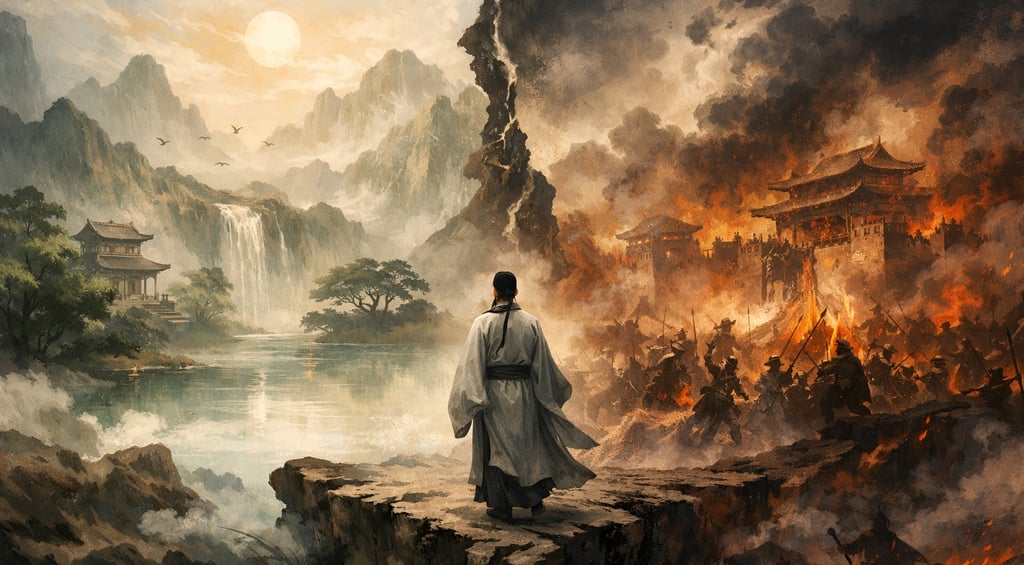
The period of Guo Xiang 郭象 witnessed the maturation of the Sima’s ruling after the transitional period of severe political oppression and the parallel renewed consolidation of the aristocracy class, and subsequently the disastrous disintegration of the political and societal order that driven chiefly by the imbalanced power distributions among the extended royal families and ignited by the sequence of critically misguided and destabilizing political decision-making and struggles.
The Guo Xiang’s milestone philosophical system of the ontological self-creation factually represented the culmination of philosophical achievement of the early Medieval Chinese aristocracy class, which the community group formed their preliminary yet essential status structure under the enduring Han period, and that status structure was further reinforced with the deepened ideological and intellectual identity that forged through the severe systematic political suppression and the following great collapse of the Han political and societal system as whole.
Within the consolidation of the Sima imperial ruling, Guo Xiang made the remarkable philosophical and ideological effort to unify the internal world from the aristocracy class with its distinctive intellectual identity, and with the external world of the actual political system of practice and governance. It was not merely the specific political condition of the Western Jin that revealed the complete failure of the idea, the failure itself could ultimately indicate the fundamental impossibility of the unification between the internal world of idealism and with the external world of concrete reality. And the unique capacity and privilege to preserve the internal world of idealism that exclusively apart from the external reality was the crucial and defining aspect of the aristocracy class in the Medieval China.
Guo Xiang completely denied the existence of the singular and ultimate metaphysical order, and that denial constituted the basic premise for the development of the philosophical system of ontological self-creation.
無既無矣,則不能生有;有之未生,又不能為生。然則生生者誰哉?塊然而自生耳。自生耳,非我生也。我既不能生物,物亦不能生我,則我自然矣。
When the No-Being is already without being, it cannot give birth to Being; and when Being is yet unborn, it cannot bring forth life. Who then is it that gives birth to the born? It arises of itself, lumpish and spontaneous. Arising of itself—this is not my bringing it forth. Since I cannot give birth to things, and things cannot give birth to me, therefore I am as I am by nature.
The idea of the singular and ultimate metaphysical order was defined as the pure nothingness, thus it was impossible to serve as the supreme order to govern and generate the world. Instead, every being in the world is entirely self-created.
是以涉有物之域,雖復罔兩,未有不獨化於玄冥者也。故造物者無主,而物各自造;物各自造而無所待焉,此天地之正也。故彼我相因,形景俱生,雖復玄合,而非待也。明斯理也,將使萬物各反所宗,於體中而不待乎外,外無所謝而內無所矜;是以誘然皆生,而不知所以生,同焉皆得,而不知所以得也... 則萬物雖眾而共成乎天,而皆歷然莫不獨見矣。
Thus, in traversing the realm where beings appear, though phantoms and shadows abound, there has never been one that does not undergo its own solitary transformation in the dark and the obscure. Therefore the Maker of things has no mastership, and each thing fashions itself; and since each fashions itself, it depends on nothing—this is the proper order of Heaven and Earth. Hence, the other and the self arise mutually; form and shadow come forth together. Though they merge in mystery, yet there is no dependence therein. To illumine this principle is to let the myriad beings return each to that which they revere—rooted within their own substance, awaiting nothing from outside. From outside, there is nothing to reject; within inside, nothing to pride in. Thus they come forth lightly and unbidden, knowing not whence their life arises; they attain in common, knowing not how they attain. …Then, though the beings be many and all are perfected under Heaven, yet each stands clearly revealed, and none fails to realize its own solitary vision.
The process of self-creation is regarded as intrinsically mysterious and beyond any rational explanation. The process emerges out of the undefinable metaphysical universe that transcending any philosophical attempts of explanations and interpretations The complete undefinedness and indeterminacy of the logic and origin on the process of self-creation grants each being created to possess their own absolutely independent ontological inner world, as in essence each being created exists as the completely independent and self-sufficiency entity.
體夫極數之妙心,故能無物而不同,無物而不同,則死生變化,無往而非我矣。故生為我時,死為我順;時為我聚,順為我散。聚散雖異,而我皆我之,則生故我耳,未始有得;死亦我也,未始有喪。夫死生之變,猶以為一,既睹其一,則說然無係,玄同彼我,以死生為寤寐...吾未見足以纓第其心也。
He embodies the wondrous mind that has reached the utmost of number and measure; therefore he can be without things and yet not be different from them. Being without things and yet not being other, life and death, transformation and change—wherever they go, none is not myself. Thus, when life comes, it is the season of my being; when death arrives, it is the course of my compliance. The season is my gathering; the course is my dispersal. Though gathering and dispersal differ, yet both are mine; therefore life is but myself, and never was there any gain; death is myself as well, and never was there any loss. The changes of life and death he regards alike as one. Having once beheld this One, he rests unbound and without attachment, mystically one with self and other—taking life and death as waking and sleeping... Never have I seen aught sufficient to bind and fetter his heart.
Within the completely independent and self-sufficiency ontological inner world from each being, the whole world order is being completely internalized. As the inner ontological world is inherently accompanied with the constant mind of serenity and stillness, any substantial changes and transformations concerning the subjects, encompassing even the rise and fall and very life and death of the particular being, should not inflict any mindful influence onto that inner ontological world. The completely internalized world order by principle should be fused into the oneness with the inner ontological world.
苟足於其性,則雖大鵬無以自貴於小鳥,小鳥無羨於天池,而榮願有餘矣。故小大雖殊,逍遙一也。
If one is wholly satisfied within his own nature, then even the Great Roc has naught by which to esteem himself above the small bird, nor has the small bird any longing for the Celestial Lake; in this, each possesses honour enough. Thus, though small and great differ in form, in their free wandering they are one.
舉其性內,則雖負萬鈞而不覺其重也;外物寄之,雖重不盈錙銖,有不勝任者矣。為內,福也,故福至輕;為外,禍也,故禍至重。
If one raises all within to its own inward nature, then though he bear the burden of immeasurable mass, he is unaware of its heaviness; but when outer things are imposed upon him, though the burden be but a mote, there are times when he cannot endure it. To act from inward—this is blessing, and thus blessings come light. To act from outward—this is calamity, and thus calamities fall heavy.
As the whole world order is fully internalized and integrated into the oneness with the inner ontological world from the self-creation, the differences among subjects seemingly exist externally are meant to be entirely eliminated and dissolved. The universal equality and freedom that in the completely unrestricted essence will be approached essentially and exclusively through the ultimate cultivation of the inner ontological world.
苟足於天然而安其性命,故雖天地未足為壽而與我並生,萬物未足為異而與我同得。則天地之生又何不並,萬物之得又何不一哉。
If one is fulfilled in what is Heaven-given and rests securely in his allotted nature and destiny, then though Heaven and Earth are not sufficient to be called his lifespan, yet they are born together with him; and though the myriad things are not enough to be deemed other, yet they attain together with him. Then why should not the life of Heaven and Earth be taken as shared with him? Why should not the attainment of the myriad beings be taken as one with his own?
Ultimately the individual inner ontological world would be in the complete unity with the whole nature and universe, as the same configuration of the nature and universe has already been mirrored and rooted within the inner world.
The self-created ontological inner world that incorporated the complete order of the world functioned as the philosophical expression and representation on the complete independence of the intellectual mind and identity of the aristocracy group. The formation and establishment of the aristocracy group as the class structure is entirely predetermined and preordained beyond the reach of explanation and inquiry. The aristocracy as the individual constituted the completely independent inner ontological world that is in the full unity and oneness with the entire order and essence of the nature and universe.
夫理有至極,外內相冥,未有極遊外之致而不冥於內者也,未有能冥於內而不遊於外者也。
For principle has its utmost reach, wherein the outer and the inner merge in obscurity. Never has there been one who could roam to the utmost outside without also being merged with inside; nor has there ever been one who could be merged with inside who did not also freely roam outside.
However, Guo Xiang’s philosophical goal and ambition extended beyond the completion and perfection of the ontological inner world. In fact, the establishment of the complete ontological inner world with the whole order of world and universe internalized with, serves as the indispensable condition for his truly final and ultimate project of the absolute unification of the inner world with the external reality.
夫聖人雖在廟堂之上,然其心無異於山林之中
Though the Sage stand above in the halls of state, yet his mind is no different from one dwelling in the mountains and forests.
By positing the sage as the ideal exemplar, the nature of the full active engagements into the political executions is understood as being fundamentally identical to the mind and desire of the complete withdrawal from the external reality.
夫體神居靈而窮理極妙者,雖靜默閒堂之裹,而玄同四海之表,故乘兩儀而御六氣,同人群而驅萬物。苟無物而不順,則浮雲斯乘矣;無形而不載,則飛龍斯御矣。遺身而自得,雖淡然而不待,坐忘行忘,忘而為之...
He whose embodied spirit abides in numinous clarity, who exhausts principle and reaches the utmost subtlety—though he sit in stillness within a quiet hall, yet is he mystically one with that which lies beyond the four seas. Thus he rides upon the Two Modes and guides the Six Breaths; he joins himself with humankind and drives the ten thousand things. If there be nothing that does not accord with him, then the drifting clouds become his chariot; if there be no form that does not bear him, then the flying dragon becomes his mount. Casting aside the body yet attaining himself, he remains serene and free from all dependence. Seated, he forgets the seat; walking, he forgets the path; in forgetting, he brings all into being...
The full-scale comprehensive engagement into the even overwhelming worldly affairs, under Guo Xiang’s ultimate philosophical pursuit, is essentially the critical component of the complete ontological inner world, and it is entirely incorporated into the fully internalized order of world and universe. Under this philosophical logic, the fulfillment of the political purposes and pursuits, and in the broader context, the quest for the secular achievements and successes are in the full equivalent with the embodied practices and meditations of the freedom of mind at the own inner world. The presence and practice of the materialist and practical pursuit at the external world of reality and the cultivation of the supreme freedom of the spirit are existed fundamentally as the perfect and absolute unity that dissolves the border of internal and external world.
夫聖人因物之自行,故無迹。然則所謂聖者,我本無迹,故物得其迹,迹得而強名聖,則聖者乃無迹之名也。
The Sage follows the self-movement of things, and therefore leaves no trace. Thus, what is called ‘sagehood’ is that I myself have no trace; because I have no trace, things are able to obtain their own trace. When that trace is obtained, it is forcibly named ‘sagely.’ Therefore the Sage is but a name for one who has no trace.
The methodological approach to the practical engagements and operations on the worldly affairs, from the ideal sagely conduct, still having the overwhelming and primary focus on preserving the distinctive nature of individual, and particularly for their unified world of inner and outer realm. Within the discourse that reflecting the prevailing political condition, the pronounced autonomy and the entrenched privileges of the aristocracy class are continued to be guaranteed and protected, but meanwhile their full and active political participations and involvements into the centralized political structure are institutionally mandated and enforced.
若獨亢然立乎高山之頂,非夫人有情於自守,守一家之偏尚,何得專此!
If one were to stand aloof and exalted upon the summit of a high mountain—were it not that he harbours a fondness for guarding himself, and clings to the partial virtues of a single school of thought—how could he presume to claim such exclusivity?
Correspondingly, the philosophical conviction of the exclusive devotion to the inner idealized world that signifies the critical articulation of the defining aristocracy identity in the Medieval China, has been negated under the critics that merely the fragmented values have been maintained and hence on its failure to adequately represent the essential and complete unity of the internal and external world.
人之生也,可不服牛乘馬乎?服牛乘馬,可不穿落之乎?牛馬不辭穿落者,天命之固當也。苟當乎天命,則雖寄之人事,而本在乎天也。
In human life, can one but yoke oxen and ride horses? And when one yokes oxen and rides horses, can one but put reins and bit upon them? That oxen and horses do not resent the rein and bit is because such is rightly ordained by Heaven. If a thing accords with Heaven’s decree, then though it is entrusted to human usage, its root still lies in Heaven.
But the true failure is only precisely emerging and happening through that impossible unity of the internal and external world. The ultimate philosophical pursuit of the complete unity on inner and outer realm is intrinsically inseparable from the implicit but powerful justification and endorsement of the full conformity and submission to the external system of ruling and order. Each subject, even with their respectively unique internalized world, is enforced to be unconditionally disciplined. That disciplinary submission is philosophically categorized as being predetermined by individual predetermined nature and serving as the necessity to form the inner-outer unity.
The compulsory integration of the enforced disciplinary submission to the external system of order into the ultimate philosophical idea of inner-outer unity, in consequence, deeply expose the inherent unsustainability and contradiction that rooted in such philosophical ideology.
The submission to the external systematic order and discipline means the fundamental collapse and corruption of the internal world that precipitated by the severe loss of the authenticity of the internal transcendental idealism, which for such form of the transcendental idealism though being responsive to the external influence at the initial stage, can only subsist and flourish through the complete deviation from the external system.
The complete and unprecedentedly catastrophic collapse of the Western Jin dynasty, although being historically exceptional in its abruptness, standing as the extreme yet compelling case that demonstrating the predestined failure of the Guo Xiang’s ultimate philosophical inquiry of the inner-outer unity. The external world, and more specifically the external system of order and discipline, despite its diverse representation forms, is intrinsically corrupted in its very nature. The miserable attempts on the philosophical pursuit of the ultimate unity, therefore, must be abandoned. The sole authentic path lies in the exclusive preservation of the internal idealized world, which is also the most crucial principle of defining the true Medieval Chinese aristocracy as the unique historical existence.
*** This essay is written for Postgraduate program of World History and Philosophy at King's College London, and it is part of trilogy on Wei-Jin Medieval China Metaphysical Confucianism that under the Medieval China series.